
This Week
Data centers could lower PG&E bills but create other problems
Get ready for wildfires one step at a time
Higher risk for big wildfires this Thursday and Friday
Correcting clean energy myths
Free heat pumps for California mobile homes
Brief climate news
Climate jargon explained
Contacts for Santa Cruz County
About me
Unrelated advice
Click on the underlined links to learn more.
Data centers could lower PG&E bills but create other problems
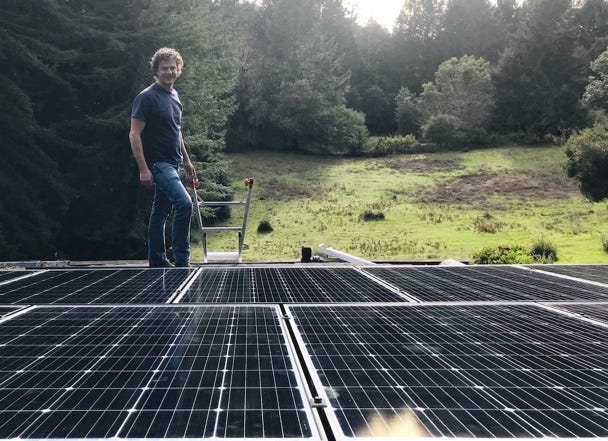
Homeowner installing rooftop solar panels in Bonny Doon, from the article
Analysis: Giant companies building giant AI data centers need a lot of electricity faster than PG&E can build natural gas power plants. Instead, we could make them install solar panels and big batteries for free at homes.
This would supply power to the data centers much sooner. While reducing utility bills for millions of people like you and I. Especially in low-income and disadvantaged areas.
There are two kinds of AI. LLM AI gobbles huge amounts of electricity, and gives wrong answers too often. Specialized AI uses trustworthy information to give you correct answers in areas like medicine and engineering, but needs a lot less electricity. Many experts and customers think that LLM AI is failing, while specialized AI is growing.
Getting free solar panels and big batteries seems like a great idea. But this might not work out in a few different ways.
Do all that, and LLM AI data centers succeed. Many people get lower utility bills. But none of that solar power reduces air pollution and climate pollution from the natural gas power plants that still supply a big chunk of our electricity. Then global overheating reaches tipping points. And climate change problems get much worse for thousands of years.
Do all that, then LLM AI data centers shut down. Because that kind of AI doesn’t work well. Or data centers shrink as the software and chips improve. Many people still get lower utility bills. In the long run, that rooftop solar power reduces climate pollution from natural gas power plants. Except we need to do that as soon as possible.
Or we could stop building giant data centers. Then remove expensive rules around installing rooftop solar panels and big batteries, like they did in Australia. Installation costs fall. Money to help low-income homes goes much farther. Lots of people get lower utility bills. And we reduce air pollution and climate pollution faster, helping to avoid tipping points.
Plus giant data centers bring serious problems. Like:
Lots of climate pollution from building them and their computers
Higher local temperatures as all that electricity literally gets turned into hot air.
Using lots of water to keep the computers cool.
And noise pollution, air pollution, and climate pollution from backup generators that run much more than promised.
New York state stopped data center development for a year while they figure out what to do. New Jersey passed a law like the one proposed for California. In part because data centers have added $20 a month to electric bills, with more hikes planned. But homeowners won’t get solar panels, big batteries, or heat pumps for a couple of years.
Let’s wait and see how that turns out.
Quote: “As data center development threatens to hike up utility bills, deplete our natural resources, and create uncertainty for New Yorkers, it’s my responsibility to take action,” said Governor Kathy Hochul.
Limitations: The California group promoting this approach says it still needs a lot of research and analysis. They should also figure out how to fix the problems I’ve described above.
Actions: Before you support something that seems like a good idea, find out if others have found big problems.
Source: Angela Lipanovich and Jenny Folkesson, Lookout Santa Cruz, 5-minute read
Get ready for wildfires one step at a time
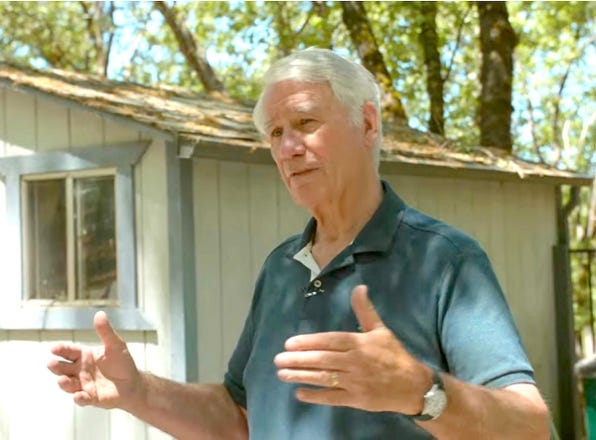
Homeowner explaining how wildfire preparation is always a work in progress, from the video
It’s easy to get overwhelmed by all the work needed to prepare your home for wildfires. Many official lists are long, and they get longer every year. Plus it’s almost impossible to do all of that in one season, or even one year.
Make a simple plan with a few sections. Like “every year” chores. Then high, medium, and low priority long-term tasks. Focus on the ones that improve wildfire safety the most.
Your goal is to make the property look like a park. With widely spaced trimmed-up trees, no underbrush, and a good amount of open space around buildings. This helps your house resist catching fire, and helps firefighters defend your home.
Every year you should remove dead leaves and branches from the roof and gutters. We pay someone to do that for our two-story house. And a few times every year I use a weed whacker to trim the wilder areas nearby.
Long term, start with the first 5 feet around your house, also called Zone 0. Even there, take small steps. Gradually remove things that can burn, and replace them with good-looking things that can’t. Most of our house now has gravel and stepstones around it, instead of mulch.
“Preparing your home for wildfire is a work in progress,” said homeowner Hugh Council. “Still have a lot of work to do. But we just keep picking away at it.”
“If I’m not here and a fire occurs, there is a very good chance that my house will survive.”
CAL FIRE TV, 3-minute video
Higher risk for big wildfires this Thursday and Friday
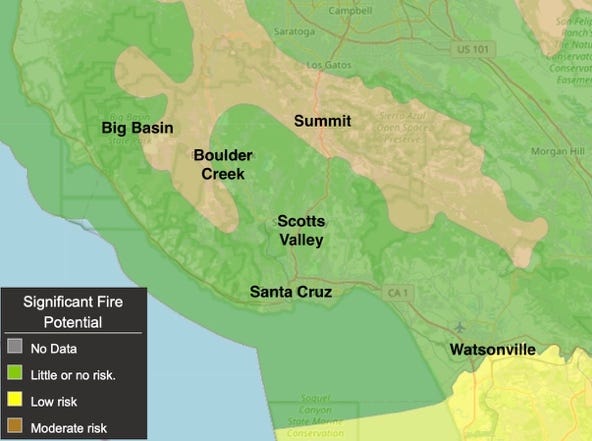
Light brown map areas show higher risk on both days, from the article
A large part of Santa Cruz County will be at moderate risk for significant wildfires later this week. Including the Summit area, much of the San Lorenzo Valley, and parts of Big Basin Redwoods State Park. Many of the trees survived the 2020 CZU fire, and have sprouted new leaves and branches.
It’s a couple of months before the traditional start of fire season. But our chances are already climbing because of global overheating.
As always, be careful with fire, and anything that could cause sparks. Like chains dragging while towing trailers, or lawnmower blades striking rocks .
National Interagency Fire Center, 1-minute read
Correcting clean energy myths
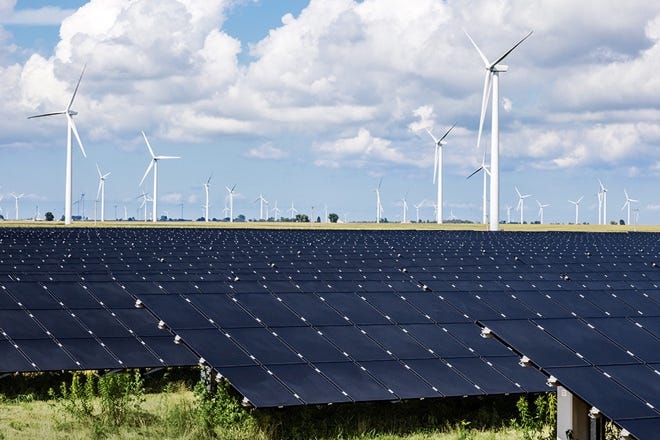
Wind turbines and solar panels, from the article
You can find wild claims about clean energy on social media. And in ads from dirty energy companies. Even from government officials. Here are a few corrections.
Myth: Clean energy costs too much.
Reality: Almost all clean energy projects produce electricity that costs less than coal, oil, or natural gas. The prices of solar panels and wind turbines have dropped dramatically and should continue falling. Clean energy saves the world about $500 billion in fuel costs every year. Plus the price of electricity from solar panels and wind turbines doesn’t soar when the Strait of Hormuz closes.
Taxpayers like you and I provide billions of dollars every year in subsidies to coal, oil, and natural gas companies. Yet they also cause over $700 billion in pollution damage.
Myth: Clean energy is not reliable.
Reality: Big utility batteries store extra solar power and wind power. Then they send that stored electricity to the electric grid when the sun isn’t shining and the wind isn’t blowing. Again, the prices of big utility batteries have dropped dramatically and continue falling.
Myth: Clean energy kills jobs.
Reality: Dirty energy jobs started dropping long before clean energy started growing fast. In 2024, clean energy added 10 million jobs, while dirty energy jobs dropped by 3 million. And about half of those workers have skills that the clean energy industry needs.
Myth: The switch to clean energy is too slow.
Reality: In the rest of the world, clean energy growth continues breaking records. Especially since we started a war with Iran.
If someone you know repeats these myths, please gently correct them.
Gary Griggs, Santa Cruz Sentinel, 5-minute read
Free heat pumps for California mobile homes
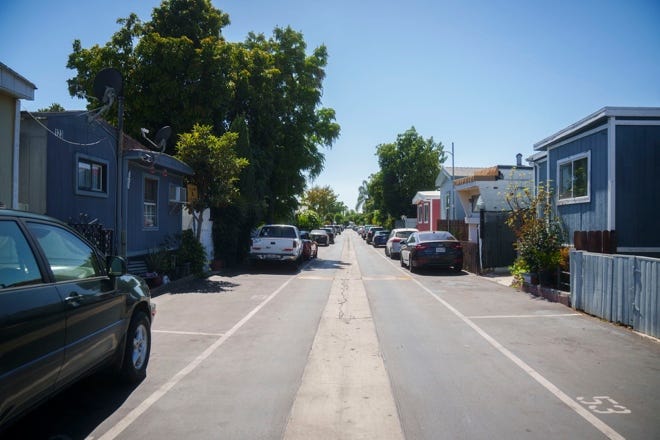
Mobile home park where free heat pumps were installed, from the article
A contractor in Los Angeles installs heat pumps and heat pump water heaters in the mobile homes of low-income owners for free. He does this by combining state incentives, bulk purchases, and working on one mobile home park at a time. The residents get clean heating, cooling, and hot water, plus lower total utility bills. And they make less climate pollution.
The contractor finds most customers by going door-to-door. Maria Franco’s hot water heater was broken. And her small air conditioner couldn’t keep up with hot summer temperatures.
“When I needed help the most, it came,” said Franco. “If it weren’t for them, we’d be suffering from the heat.”

Mobile home owner keeps cooler and warmer at lower cost, from the article
Now Franco spends about $150 less every month on utility bills. And one of her neighbors is much healthier after replacing her old natural gas heater.
A creative contractor in Santa Cruz County could do this. We have more than 6,000 mobile homes, many owned by people with low incomes.
Laura Klivans, KQED, 9-minute read
Brief climate news
Solar panels on rooftops and parking lots at a Southern California hospital are paid for with a long-term power contract. We could use those at hospitals and clinics in our county. Solar Power World, 1-minute read
Free climate change podcast game lets young people choose their own adventure and save the world. Includes how to take action and keep learning. WBUR, 3-minute read
There was a major blackout somewhere in the U.S. every month this year. If you can, install solar panels and batteries at your home or business for energy independence. Electrek, 4-minute read
Free yard waste disposal program in part of our county reduces wildfire damage and climate pollution. Might cover most of the county next year. Santa Cruz Sentinel, 5-minute read
Climate jargon explained
Big utility battery: Utility-sized rechargeable battery in a shipping container that stores clean electricity for later use
Clean energy: Low cost energy from the sun, wind, dams, or underground heat, that creates very little air pollution or climate pollution
Climate: Long-term weather pattern
Climate change: Long-term changes to Earth’s weather caused by climate pollution, including global overheating and too much ocean acid
Climate pollution: Gases in the air that trap the Sun’s heat and cause climate change, mainly carbon dioxide and methane, also called greenhouse gases
Defensible space: Area around a building designed to reduce fire danger and provide a safe area for firefighters
Dirty energy: Expensive energy from coal, oil, or natural gas, that creates air pollution and climate pollution
Electric grid: How most places get electricity, using power plants, storage, substations, and overhead power lines
Global overheating: Rapid increase in worldwide temperatures starting around 1970, also called global warming
Heat pump: Two-way air conditioner that can cool or heat a building, heat a hot water tank, or boil water for factories
Methane: Climate pollution gas 80 times worse than carbon dioxide, second-worst cause of climate change
Natural gas: Fuel pumped from underground, almost all methane, that adds climate pollution when it always leaks, and when it’s burned for power or heat
Rooftop solar power: Solar panels mounted on a roof, supplying electricity
Solar panel: Panel covered in solar cells that turns sunlight into electricity
Solar power: Clean electricity made from sunlight, mostly using solar panels
Tipping points: High global temperatures that would cause big, permanent damage
Whole home battery: Large battery permanently installed in a home to lower electric bills and supply power during blackouts
Wind power: Clean electricity made from wind blowing through wind turbines
Wind turbine: Tall machine with long blades like a propeller, that makes clean electricity when the wind blows
Zone 0: Five feet next to a house or building that must be cleared of anything that burns, including plants, wooden fences, and mulch
More at climatejargon.com
Contacts for Santa Cruz County
City council: Watsonville, Scotts Valley, Santa Cruz, or Capitola, depending on where you live
County supervisors
County Resource Conservation District
Regional Transportation Commission (SCCRTC)
Central Coast Community Energy (3CE) and PG&E
State Assembly: Gail Pellerin, Dawn Addis, or Robert Rivas, depending on where you live
State Senate: John Laird
California Public Utilities Commission (CPUC), Air Resources Board (CARB), and Energy Commission (CEC)
Governor Gavin Newsom
U.S. Congress: Jimmy Panetta or Zoe Lofgren, depending on where you live
U.S. Senate: Alex Padilla and Adam Schiff
About me
I’m Rex Sanders, a science writer who’s lived in Santa Cruz County more than 20 years. Each week I check dozens of reliable sources for climate news that affects our county. Focused on how we can create a better, safer future together.
Unrelated advice
There is inherited wealth in this country and also inherited poverty.
John F. Kennedy